Strategy & advisory
I work with governments, distribution networks, NGOs, research bodies and industry to design and implement strategies for integrating DER in ways that lower costs, cut emissions and improve consumer outcomes.
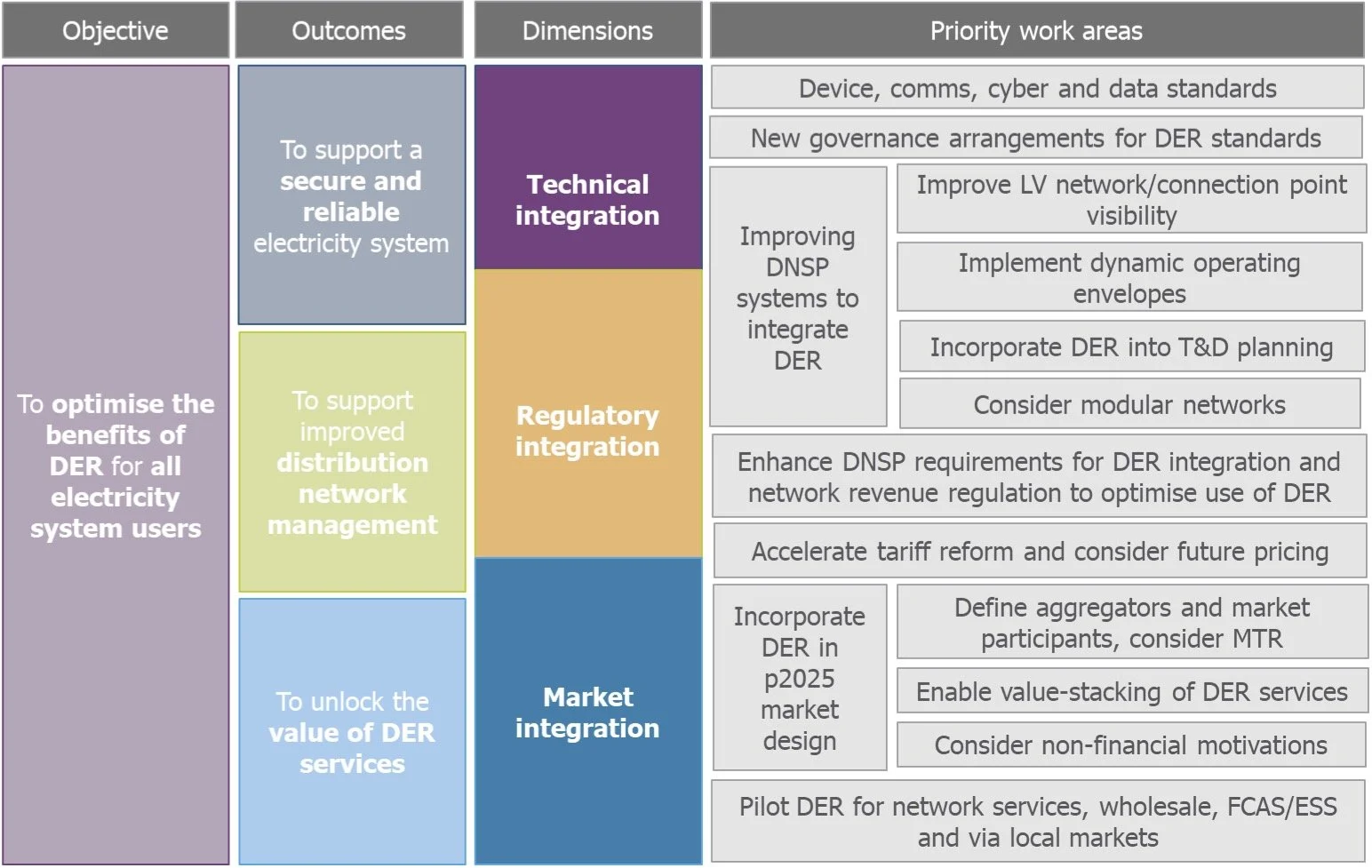
Diagram below is from Australia’s first DER Roadmap I developed for the Energy Security Board in 2019
1. DER strategy
-
DER Roadmap for Peninsular Malaysia
Led for Blunomy for MyPower, Malaysian Government, 2024-25
This will be the first DER strategy for Southeast Asia, but it is yet to be publicly released.
I led the roadmap development for Blunomy, including stakeholder engagement, technical, regulatory and market recommendations development, risk assessment and implementation timetable.
-
DER Integration Roadmap and Workplan for the Australian Energy Security Board (ESB)
Developed and implemented for the ESB, 2019-2020 Download the PDF
This was Australia’s first national DER strategy, published September 2020. An internal unpublished roadmap and workplan was developed in October 2019.
The aim of the ESB’s DER Integration Roadmap and Workplan was to optimise the benefits of DER for all electricity system users, not just DER owners, reducing total system costs and ensuring a secure, reliable grid. In included plans for the following:Technical Integration: Addresses device standards (e.g., inverter standards like AS4777), ride-through capabilities, communications, interoperability, cybersecurity and dynamic operating envelopes.
Regulatory Integration: Calls for updating the National Electricity Rules and regulatory frameworks so DNSPs are incentivised and responsible for efficient DER integration, including new approaches like modular networks, including SAPS and microgrids.
Market Integration: Includes tariff reform, enabling DER participation in emerging markets (FCAS, wholesale, network services) and facilitating value-stacking (multiple services from one DER installation).
It also includes a timeline:
2020–2021: Implementation of foundational DER technical standards, commencement of dynamic operating envelope trials and improved governance structures for standards.
2022–2025: Interoperability/cybersecurity standards in place, DNSPs advance network management, enhanced market rules for DER participation, and broader market designs for DER aggregation and value stacking.
-
Submission to the Senate Inquiry into Energy Planning and Regulation
Solar Citizens, 2024
This is an analysis of the Australia’s National Electricity Market (NEM) institutions—AEMO, AER, AEMC, and ECA—which finds they are dominated by supply‑side and industry interests, leaving them poorly aligned with the urgent need for rapid decarbonisation and better integration of DER. It finds that weak role clarity, limited accountability, and slow rule‑making have impeded progress on renewables, flexible demand, and consumer outcomes, costing Australians billions. The paper recommends a Productivity Commission review of energy market governance, clearer ministerial direction toward decarbonisation, cultural and structural reform of the institutions, and potential consolidation of the AER and AEMC into a new Commonwealth Energy Regulator.
-
Integrating Distributed Energy Resources in China - Lessons from international experience
Peer reviewed for the IEA, 2025
PDFAn interesting overview of where DER integration progress is at internationally and in China.
-
Unlocking the Potential of Distributed Energy Resources
Peer reviewed for the IEA, 2022
The IEA’s first report on DER! It’s a good overview, albeit with a major focus on market-integration.
2. DER technical integration
-
Smarter homes for distributed energy: Towards home energy management systems that respond to dynamic operating envelopes and unlock distributed energy
With Enea Consulting (now Blunomy) for ARENA, February 2022
This ARENA-funded study assesses the technical and commercial readiness of home energy management systems (HEMS) to orchestrate household energy assets in response to dynamic rather than static import/export limits (dynamic operating envelopes, DOEs). The report finds that HEMS can already technically manage DOEs, but calls for progress on national interoperability standards, regulatory cyber security requirements, harmonisation of DOEs across networks, robust compliance frameworks, and expansion of customer value streams through new market and network services.
-
Project Edith: Unlocking more value for and from distributed energy resources by evolving the services that distribution networks offer
With Enea Consulting (now Blunomy) for Ausgrid, 2022
Project Edith is a leading Australian demonstration of dynamic network pricing being run by Ausgrid. This report gives an overview of the decentralised allocation of network capacity where customers and aggregators respond to real-time network price signals and operate within DOE ‘guardrails.’
3. DER regulatory integration
-
Beyond batteries: heavy lifting to do before the grid supports consumers
The Energy, 2025
This article stresses that while distributed batteries and other consumer/distributed energy resources (CER/DER) are important, Australia’s electricity system requires much more than technology deployment to realise the benefits for consumers and the grid. It offers some suggestions.
4. DER market integration
-
NEM Reform: Unlocking the demand side in future energy markets
with Dr Dylan McConnell for the Energy Efficiency Council, supported by RACE For 2030, 2025
PDF, The Energy article, RenewEconomy article,
Dr McConnell and I prepared this report to feed into the 2025 NEM review. We set out a comprehensive discussion of the issues and recommendations including lowering market entry thresholds, supporting innovation for demand-side aggregators, revising network and investment incentives, evolving subsidy programs to reward flexibility, and establishing strong technical standards and data access for integration and value stacking.
-
Aligning market settings, policy and programs with consumer outcomes in a decarbonised NEM: Solar Citizens Submission to National Electricity Market (NEM) Review
For Solar Citizens, September 2025
This submission commends the NEM Review Panel’s work but argues the draft report remains overly focused on traditional spot market approaches, neglecting the pivotal role that distributed, behind-the-meter (BTM) resources—especially flexible hot water—can play in delivering a reliable, decarbonised energy system. Citing substantial savings and flexibility potential from electrifying and controlling domestic hot water, it calls for expanded demand-side participation, lessons from international demand flexibility markets, and specific reforms including extending the Wholesale Demand Response Mechanism (WDRM) to aggregations of small users and adopting more flexible baseline methodologies to unlock the full value of distributed assets for all consumers.
-
Optimising the use of Distributed Energy Resources (DER) in future markets in the interests of consumers: Submission to the NEM Wholesale Market Settings Review
For Solar Citizens, February 2025
PDF, PV magazine article
This first submission to the 2025 NEM review calls for wholesale reform of the NEM to unlock the full economic and resilience benefits of Aggregated DER (ADER), arguing that current market, regulatory and technical arrangements systematically disadvantage distributed resources compared to centralised supply. It recommends reducing minimum bid sizes, ensuring fair and stackable compensation, enabling all forms of DER aggregation to access all markets, and modernising market systems and technical standards—including Dynamic Operating Envelopes and open protocols—to maximise value for consumers and deliver system-wide decarbonisation and reliability. Resilience, competition, consumer protection, and equity are emphasised as core principles guiding future market and system design. -
VPP Readiness Index
As an advisor to Integrate to Zero, Blunomy for Integrate to Zero, 2025
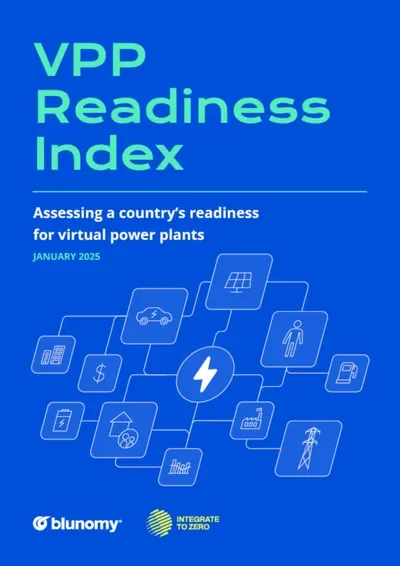
The Virtual Power Plant (VPP) Readiness Index assesses national readiness for deploying large-scale VPPs using technical, regulatory and commercial criteria and it’s applied here across 12 countries. Any index is by necessity partial, but this provides a way for policy makers to assess their progress to deploying and integrating DER.
5. Flexible demand and smart appliances
-
Product Policy Framework for Demand Side Flexibility: Case Studies
With the Institute for Sustainable Futures, UTS for IEA 4E EDNA, February 2025
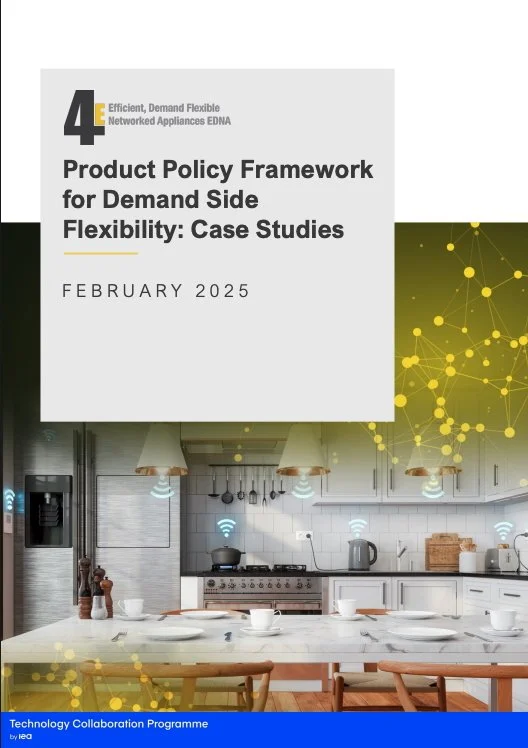
This report sets out case studies on appliance (‘product’) flexibility standards and market access for aggregated flexible devices in seven jurisdictions. It finds that energy flexibility standards are still at an early stage globally, with only limited mandatory requirements in place for select device categories. Market participation by aggregated appliances is advancing in some regions—most notably Great Britain and parts of Europe—but is often hampered by large minimum participation thresholds, patchy standards, and insufficient interoperability, underscoring the need for coordinated international requirements and open protocols to unlock demand-side flexibility in household appliances at scale.
-
DER can create cheaper, faster decarbonisation
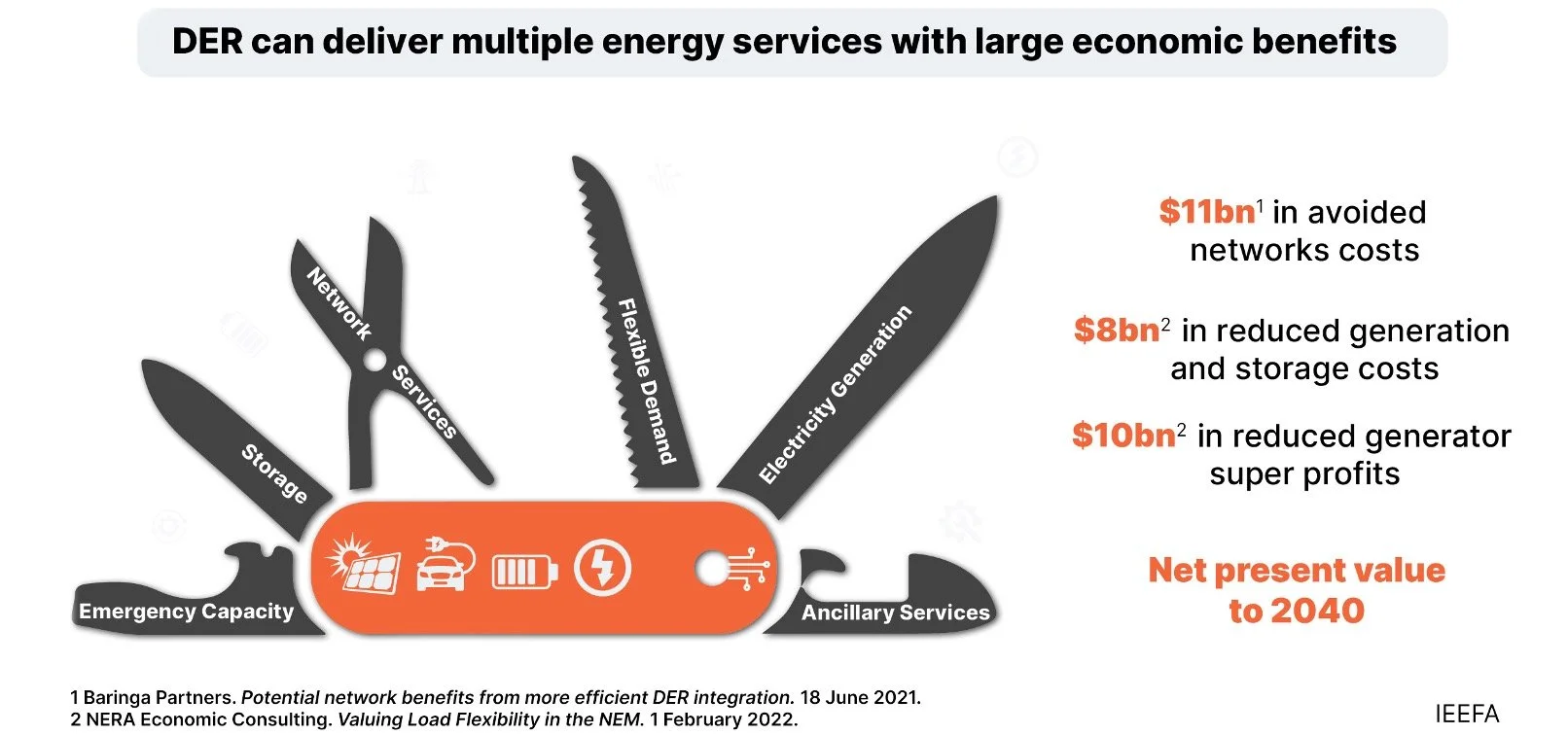
There is fundamental logic to behind-the-meter (BTM) and distribution-connected resources :
• Consumers pay more of the capital cost of the generation and storage directly, and what they purchase is co-located with load, reducing network, wholesale and retail costs.
• The smart on-site use of DER reduces the use of the network and reduces network peaks and so should reduce the cost of networks.
• The time efficiencies compared with large-scale generation and transmission construction are significant.
• The social licence issues are minimal compared with large-scale generation and transmission.